


Blog > The $34,000 Strategy Luxury Home Sellers Are Using to Beat High Interest Rates
The $34,000 Strategy Luxury Home Sellers Are Using to Beat High Interest Rates
by

If you're selling a luxury home right now, you've probably noticed the same thing every agent in this price range is seeing: qualified buyers are out there, but they're hesitant. Even households earning well into six figures are feeling the weight of where mortgage rates have landed, and that hesitation shows up as longer days on market and softer offers.
First of all, let me say, there is no "fix-all" and every situation is unique. When a listing stalls, the reflex is to cut the price. But for some luxury buyers, a straight price reduction may be a less effective way to get a deal moving. A more targeted tool like a 2-1 interest rate buydown may get the same buyer to the table for a similar cost, without you giving up equity permanently.
Here's exactly how it works, using a real $1.9 million example (roughly the median price for a single family home in Carlsbad as of July, 2026).
What Is a 2-1 Buydown?

A 2-1 buydown is a seller-funded concession that temporarily lowers the buyer's mortgage rate for the first two years of the loan:
Year 1: The rate is reduced by 2 percentage points below the note rate.
Year 2: The rate is reduced by 1 percentage point below the note rate.
Years 3–30: The loan reverts to its permanent note rate for the remainder of the term.
The money doesn't go to the buyer as cash. It's deposited into a temporary escrow account at closing, and the lender draws from it each month to subsidize the buyer's payment. The buyer gets real breathing room during the first two years of homeownership when moving, furnishing and renovation expenses can add significant cash-flow pressure.
The Real Numbers: A $1.9M Case Study
Assume a buyer is purchasing your home for $1,900,000 with 20% down ($380,000), financing $1,520,000 at a note rate of 6.5%.
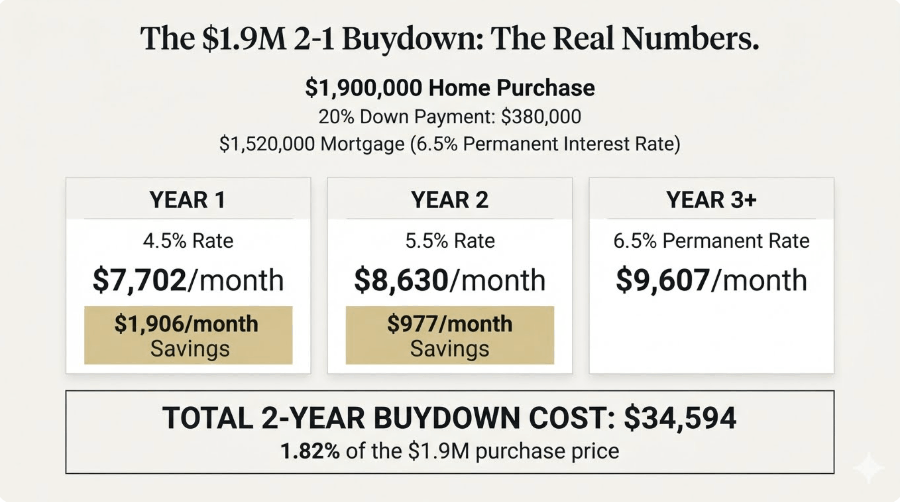 Instead of cutting $50,000 off the price, you offer a 2-1 buydown funded at closing:
Year 1 (rate at 4.5%): Monthly payment of roughly $7,701 — about $1,906 less than the note-rate payment.
Year 2 (rate at 5.5%): Monthly payment of roughly $8,630 — about $977 less.
Years 3+ (rate at 6.5%): Payment levels out at approximately $9,607, the permanent payment for the life of the loan.
The total cost to fund this is straightforward math:
Year 1 savings ($1,905.82 x 12) = $22,869.84
Year 2 savings ($977.04 x 12) = $11,724.48
Total upfront seller cost = $34,594.32
That's about 1.82% of the purchase price — funded once, at closing, through escrow.
Why This Often Beats a Price Drop
A $35,000 price reduction on this same home lowers the buyer's monthly payment by roughly $175. For a buyer already comfortable enough to be looking at $1.9 million homes, that's not a number that changes their decision.
The same $35,000 spent on a 2-1 buydown instead delivers almost $2,000 a month in relief during year one — right when the buyer is absorbing moving costs and setting up a new home. It's the same dollar amount, but it lands differently because it solves a cash-flow problem instead of a price problem.
What This Strategy Doesn't Change
 A 2-1 buydown is a strong tool, but it has real limits, and buyers and sellers should both understand them before writing it into an offer.
It doesn't help the buyer qualify for more. Most lenders still underwrite the loan at the note rate - 6.5% in this example - not the temporarily reduced first-year rate. The buydown improves cash flow after closing; it doesn't change what the buyer qualifies to borrow.
Unused funds don't follow the buyer indefinitely. If the buyer refinances or pays off the loan early, the treatment of any remaining buydown funds depends on the loan program and the specific buydown agreement. They may be applied toward the payoff or otherwise handled according to the agreement.rather than paid out or preserved as an ongoing subsidy. It's a benefit for as long as the buyer holds the original loan at its original
Create a clean, professional blog header image representing the concept of "limits and fine print" in a real estate financing strategy, such as a 2-1 buydown. Show a subtle visual metaphor like a magnifying glass over a mortgage document, or a house icon paired with a checklist and a fine-print contract, in a modern, trustworthy financial-services style with a calm blue and neutral color palette suited for a real estate or mortgage blog.
, not a permanent perk that travels with a refinance.
Not every loan program allows it the same way. At this loan amount, the buyer will likely be using jumbo financing, and buy down structures aren't standardized the way they are on conforming loans. Some jumbo lenders permit temporary buydowns, some restrict how the funds can be structured, and some don't offer them at all. This needs to be confirmed with the buyer's lender before it's marketed as part of an offer strategy. It's a negotiated contract term, not something either side can assume is available.
Tax treatment should come from a professional. Seller-paid buydown funds are generally treated as a seller concession rather than taxable income to the buyer, but that determination depends on the buyer's specific situation. Buyers should confirm with their CPA rather than treat this as settled.
Is a 2-1 Buydown Right for Your Property?
Creative financing tools like this work best when they're matched to the right price point, the right buyer profile, and the right lender. Not every luxury listing needs one, and not every buyer will value it the same way.
If you're weighing whether a 2-1 buydown makes sense for your home, reach out for a custom market analysis and we'll run the numbers together.