


Blog > Mr. President, Get The More Homes On the Market Act Passed

If Washington really wants to help the housing market, it needs to stop chasing headlines and start addressing one of the biggest problems facing the market today: too many homeowners, especially in high cost states like California, New York, Massachusetts and Connecticut, are staying put.
Not because they don’t want to move.
Not because they don’t need to move.
And not because Wall Street has bought every house and they are holding on to them.
For many longtime homeowners, the problem is much simpler: they have accumulated enormous amounts of home equity, and selling their home can create a significant federal capital-gains tax liability.
That is where the More Homes on the Market Act comes in.
A Tax Rule That Hasn’t Changed Since 1997
Under current federal law, a homeowner who qualifies can exclude up to $250,000 of gain from the sale of a primary residence. For married couples filing jointly, the exclusion is $500,000. Those limits have been in place since 1997 and have never been adjusted for inflation.
Think about how much the housing market has changed since 1997. The median home price was dramatically lower. Home values have soared in many parts of the country. Yet the federal government still uses the same $250,000 and $500,000 thresholds.
And the problem is getting worse.
According to the National Association of REALTORS®’ latest research, nearly 29 million homeowners - about 34% of all homeowners - could already have gains exceeding the federal exclusion thresholds if they sell. NAR projects that share could rise to 56% by 2030 and nearly 70% by 2035 if the exclusion remains unchanged.
That’s not a problem affecting only wealthy homeowners.
It increasingly affects ordinary Americans who bought a home decades ago, raised their families, paid their mortgages and property taxes, maintained their properties, and accumulated equity simply by owning their homes.
Now they’re discovering that the very equity they’re counting on for retirement can become a financial obstacle when they want to move.
The Stay-Put Penalty
Imagine a homeowner in Oceanside, Carlsbad, Encinitas, or elsewhere in coastal California who bought a home 20 or 30 years ago.
Maybe the kids are gone. Maybe they want a smaller, single-story home. Maybe they want to move closer to their children. Maybe they simply don’t need four bedrooms anymore.
Suppose they purchased their home for roughly $300,000 in the late ’90s and it is now worth $1.8 million. Even after accounting for their adjusted basis, selling expenses, and the $500,000 joint exclusion, a retired couple could still face a substantial federal capital-gains tax bill when downsizing.
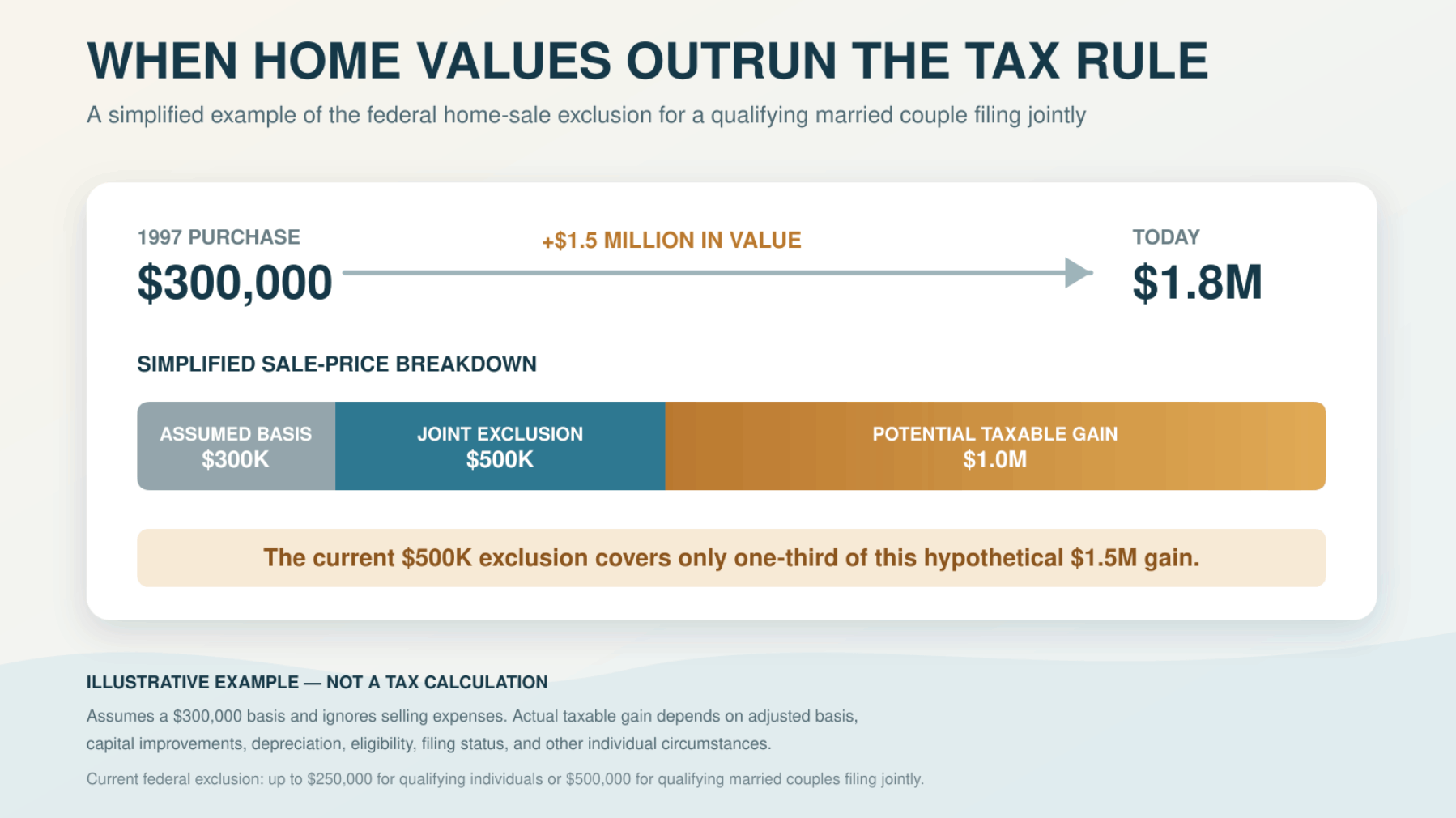
These homeowners haven’t been sitting idle. For decades, they’ve paid mortgages and property taxes, maintained their homes, and contributed to their communities. Many were ordinary middle-class buyers - not luxury real estate moguls - when they purchased their homes. Now, the federal tax code can take a substantial bite out of the equity they planned to use for retirement or their next home.
Staying put suddenly looks pretty attractive
So they stay.
When Homeowners Stay Put, the Housing Market Suffers
When they stay, their homes don’t become available to other buyers.
That’s the part of the housing debate Washington needs to understand. Available inventory doesn’t come only from new construction, especially in San Diego, where buildable land is limited. It also comes from existing homeowners deciding to sell.
One sale can create a chain reaction: a downsizing homeowner sells to a growing family, that family sells its smaller home, and another buyer gets an opportunity to enter the market.
When homeowners remain locked in place, that entire chain can stop.
This Isn't Just About Homeowners. It's About Communities
There's another consequence that gets almost no attention: local tax revenue.
In California, longtime homeowners can have assessed values far below today's market value because of Proposition 13. When a home is sold, it generally gets reassessed at its current market value. That means turnover can put a substantially higher-value property onto the local tax rolls.
So when a homeowner stays put for another decade because the federal tax code makes selling painful, the community doesn't just lose a home that could have gone to another family. It can also lose an opportunity to generate additional property-tax revenue.
More home sales mean more families moving, more housing turnover, and potentially a stronger local tax base.
The goal isn't to force people out of their homes. It's to stop the tax code from giving people another reason not to move when they're ready.
Wall Street Isn’t Buying Every House
There is a legitimate debate about institutional investors in housing. In certain markets, they absolutely matter.
But turning them into the primary explanation for America’s national housing shortage doesn’t square with the numbers.
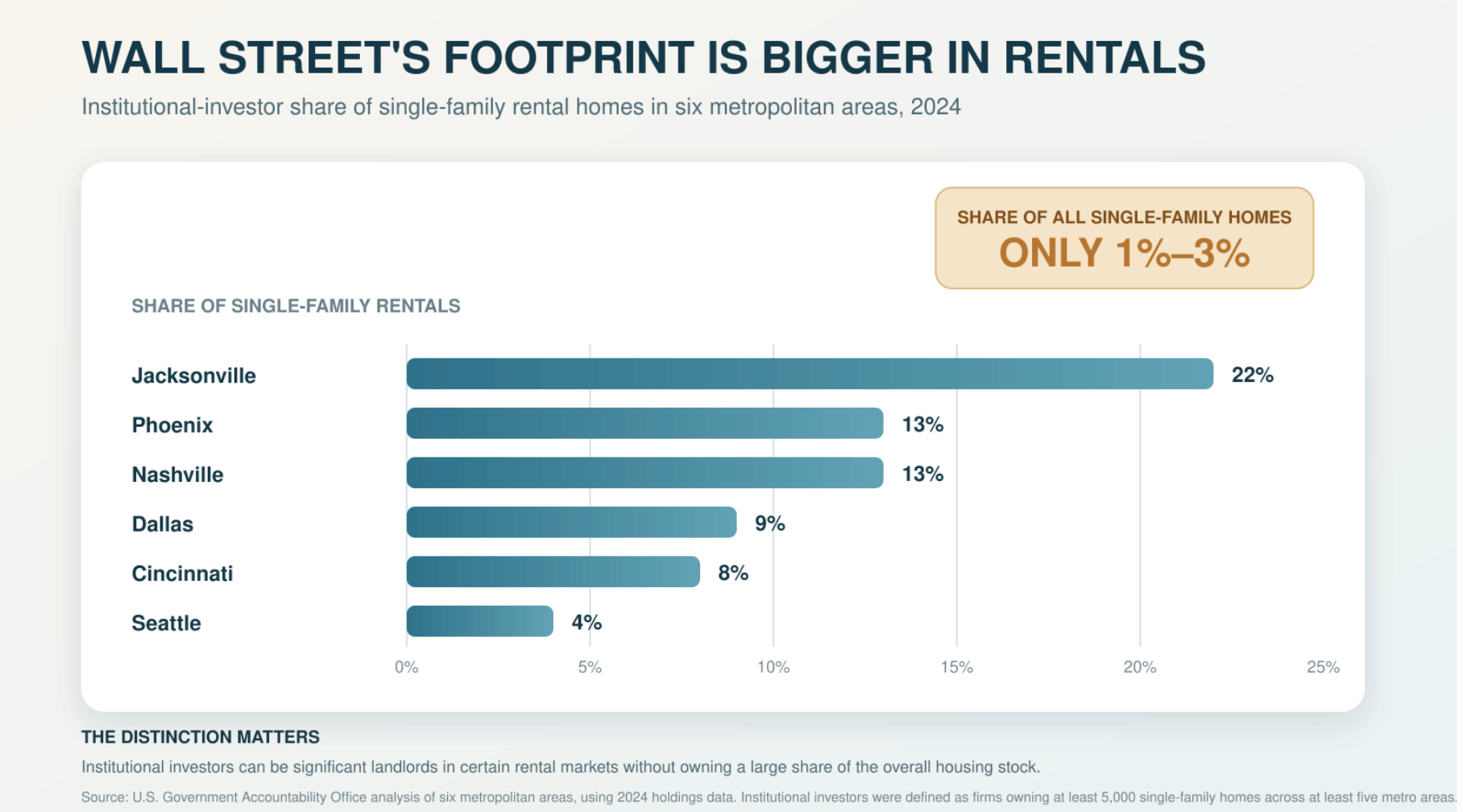
The latest Government Accountability Office analysis looked at six metropolitan areas and found that institutional investors - defined as firms owning at least 5,000 single-family homes across at least five metro areas - owned only 1% to 3% of all single-family homes in those markets in 2024.
Their presence is much larger within the single-family rental market. In Jacksonville, for example, institutional investors owned about 22% of single-family rental homes. But that’s very different from saying they own 22% of all the homes. In Phoenix and Nashville, the figure was about 13%; in Dallas, 9%; Cincinnati, 8%; and Seattle, 4%.
That’s an important distinction.
Institutional investors can have a meaningful impact in specific markets, particularly in the Sun Belt. But the available evidence does not support blaming them as the primary cause of America’s nationwide housing shortage.
NAR estimates the country is short approximately 4.7 million homes, the result of years of underproduction.
And there’s another massive factor keeping existing homes off the market.
The Mortgage Rate Lock-In Effect
Millions of homeowners have another reason to stay put: their mortgage.
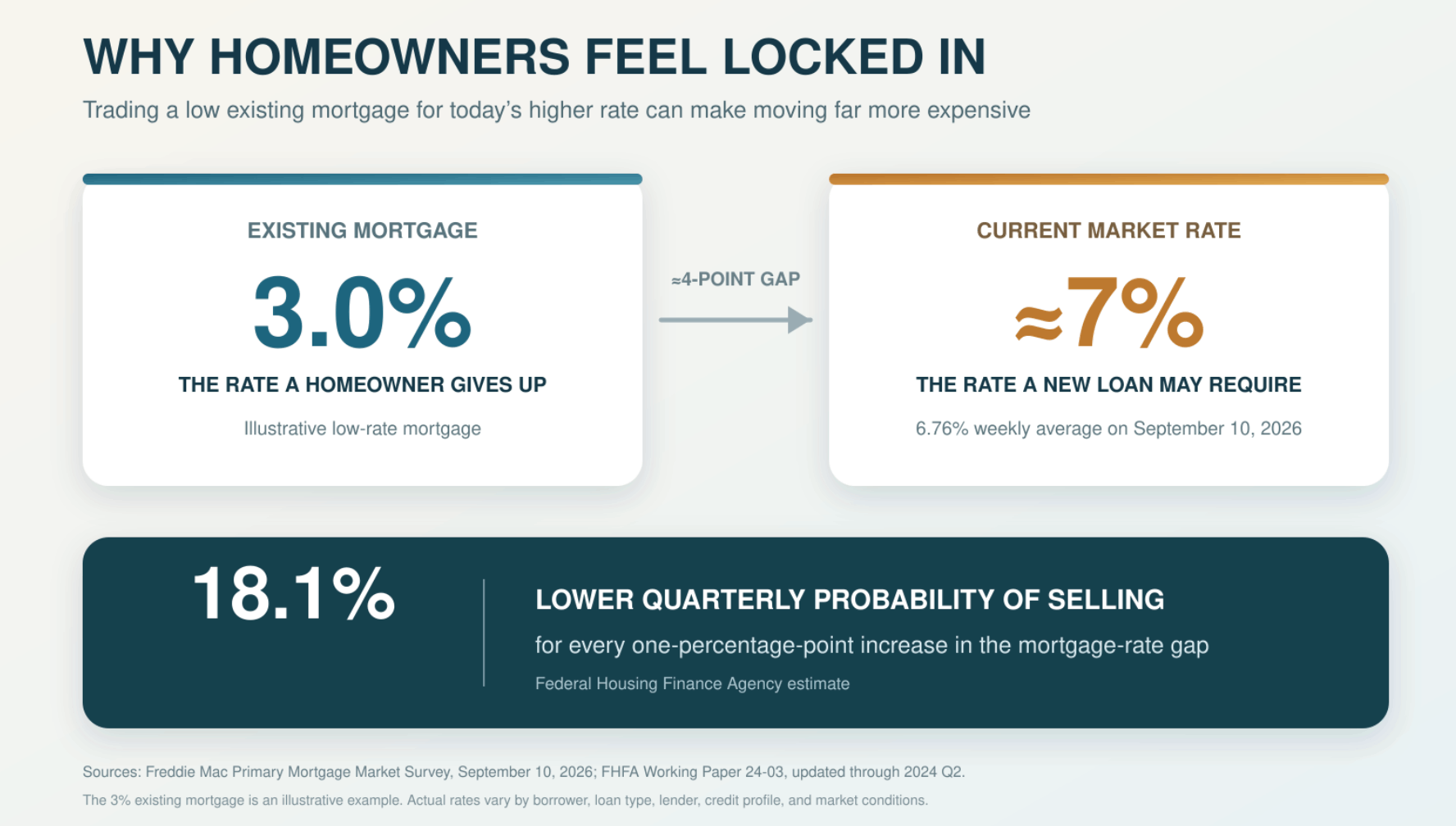
The Federal Housing Finance Agency estimates that mortgage-rate lock-in prevented approximately 1.72 million home sales between the second quarter of 2022 and the second quarter of 2024.
FHFA also found that every one-percentage-point increase in the gap between a homeowner’s existing mortgage rate and prevailing market rates reduced the quarterly probability of selling by approximately 18.1%.
So we have two very different forces working in the same direction.
Homeowners don’t want to give up their cheap mortgage.
And homeowners don’t want to trigger a potentially large tax bill on decades of appreciation.
Both discourage people from selling.
Here’s the Fix
The More Homes on the Market Act offers a straightforward solution.
H.R. 1340 would increase the exclusion from $250,000 to $500,000 for individual taxpayers and from $500,000 to $1 million for married couples filing jointly.
And unlike the current system, the new thresholds would be adjusted for inflation going forward.
That’s important.
Because simply doubling the exclusion and then allowing inflation to erode it for another 30 years would eventually put us right back where we are today.
The bill currently has bipartisan support in both chambers. The House version was introduced by Rep. Jimmy Panetta and referred to the House Ways and Means Committee. A Senate companion, S. 3332, was introduced by Sen. John Cornyn with bipartisan cosponsors and referred to the Senate Finance Committee.
As of September 2026, neither bill has received a committee vote or passed its respective chamber.
And this isn’t some fringe idea.
The issue has also reached the White House publicly. President Trump said in July 2025 that his administration was considering eliminating capital-gains taxes on home sales, an even broader proposal, although not a specific endorsement of the More Homes on the Market Act.
So the question isn’t whether Washington knows this issue exists.
It does.
The question is whether Washington is willing to do something meaningful about it.
Mr. President, Get It Done
If the goal is to make housing more affordable, America needs more homes on the market.
That means building more homes. Cutting unnecessary regulations. Making it easier to develop starter homes and missing-middle housing.
But it also means getting more existing homes onto the market.
And that’s where the More Homes on the Market Act makes sense.
The capital-gains exclusion thresholds have remained unchanged for nearly three decades. The housing market hasn’t.
Because America doesn’t just have a housing construction problem.
We have a housing turnover problem.
Call Your Federal Lawmakers
To help get the More Homes on the Market Act passed, you can reach out directly to your federal lawmakers using the contact information below:
Representative Mike Levin (CA-49)
Washington, D.C. Office Phone: (202) 225-3906
Office Address: 2352 Rayburn House Office Building, Washington, DC 20515
Senator Alex Padilla
Washington Office Phone: (202) 224-3553
Office Address: 331 Hart Senate Office Building, Washington, DC 20510
Senator Adam Schiff
Washington, D.C. Office Phone: (202) 224-3841
Office Address: 112 Hart Senate Office Building, Washington, DC 20510